How Presence Sensors Can Help Your Household Reduce Energy Waste
Power bills are set to rise in Australia this year following the expiry of government energy subsidies, resulting in many households paying higher electricity bills than before the relief. New research warns that households will face an extra $600 a year in energy bills as electricity grid transformation costs skyrocket, with major transmission projects currently running billions of dollars over budget. It is a major wake-up call for homeowners who wish to keep their bills low and lead more sustainable lifestyles to embrace these goals with a multifaceted strategy. That is, renewable energy will only take households so far. Additional strategies, such as using presence sensors, can give homes a winning edge in reducing energy expenditure.
What, Exactly, Are Presence Sensors?
Traditionally, understanding how space is used has relied on physical tools like survey markers, which define boundaries and key locations on a property. They provide users with practical information, such as boundary lines, dimensions, and reference points. In a very different way, presence sensors also help us ‘know’ how space is used, but they take it a step further by detecting real-time occupancy. They are, essentially, devices that detect whether people are in a space. Unlike motion sensors, which only detect movement, presence sensors detect the presence of occupants and micro-movements, such as breathing. The technologies used to power these sensors include infrared (PIR), ultrasonic, and mmWave radar. These sensors are typically fitted in commonly transited or lived-in spaces, including rooms and hallways.
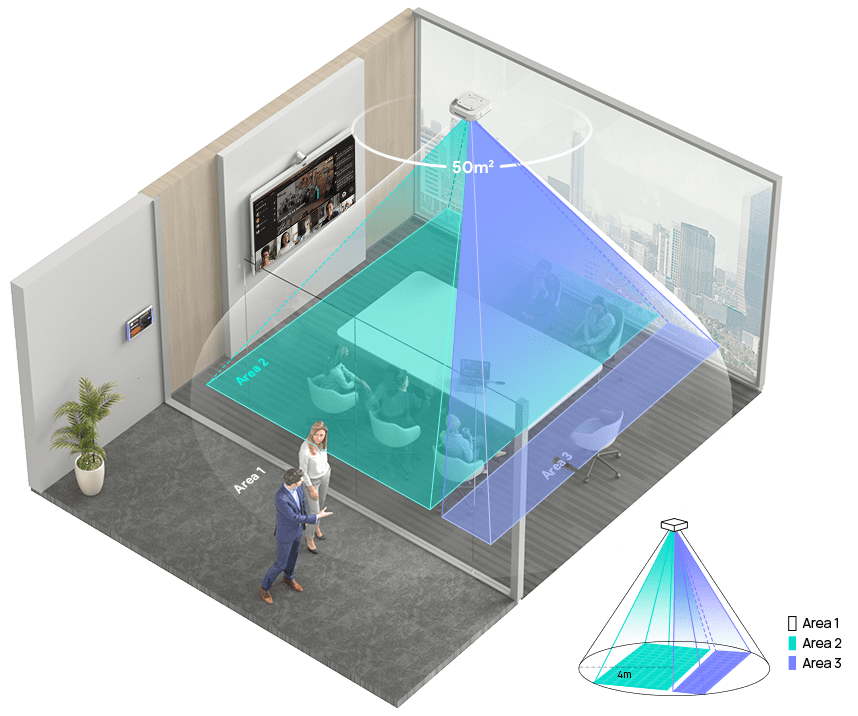
Presence sensors can differentiate motion in specific zones within a room
How Much Energy Waste Do Australians Waste?
The typical Australian household wastes $2.52 to $8.09 per week on avoidable energy use. In high-energy-use states like Victoria and the ACT, households with higher energy waste could be wasting around $9.91 and $11.84 per week, costing households more than $500 per year. Causes include leaving appliances on when not in use, leaving lights on when not needed, and leaving heating or cooling on when nobody is home. Presence sensors can help ensure that energy is utilised only when it is needed.
Presence Sensors in Action
Presence sensors can affect how home dwellers utilise everything from lighting to small appliances. For instance, they can form part of a smart lighting control system that automatically turns off lights when someone leaves or dims them based on the time of day or occupancy. Sensors can also be used to optimise HVAC use, enabling systems to adjust heating or cooling based on room usage and avoid conditioning unused spaces. Sensors can integrate with smart thermostats, ensuring homes are not overheated or overcooled. Sensors can also be used to turn off devices such as electric fans, televisions, and music systems when no one is home, thereby reducing phantom energy use. They work more effectively than timers and are more accurate than manually controlled systems.
Measurable Results
Various studies have been conducted to assess the extent to which presence sensors can achieve energy savings. One study showed that this technology can deliver 18%–24% energy savings compared to systems without presence sensors. Another found that dwellers could save between 17% and 24% of their weekly energy use in real-world building scenarios. Research on the impact of lighting-specific savings, meanwhile, has shown that depending on room usage, homeowners can save between 10% and 90% of their energy use. Controlled studies involving smart lighting systems (which included presence sensors) showed an average savings of around 30%. Bigger savings are made when rooms are often empty (as occurs in guest rooms, for instance) and when people in a home frequently forget to turn things off. It can also help to run HVAC systems on fixed schedules that reflect homeowners’ actual energy use. In contrast, lower savings occur when people are at home most of the time, when they already lead energy-efficient lifestyles, and when sensors are inaccurate or poorly installed.
Presence sensors are an excellent addition to homes with an eco-friendly heart. The media frequently highlights the benefits of renewable energy and green lifestyles, but presence sensors, when used alongside intelligent home systems, can bring significant benefits to families across Australia. Studies have shown that these sensors significantly reduce energy use and costs for lighting and HVAC systems, thus making them a pillar of many energy-efficient homes.