5 Best Whole Home WiFi Providers in Florida for Seamless Fiber Internet
Buffering Netflix during a Miami storm. Upstairs dead zones that kill video calls. Surprise year-two price jumps. If you live in Florida, you know the pain.
Help is coming. The state will spend $1.16 billion in BEAD funds on new fiber, and ISPs are pairing those lines with mesh-ready routers — a must because raw speed means nothing if Wi-Fi dies in the den.
We dug into coverage maps, contracts, and customer threads to rank providers that clear two bars: 300 Mbps to the door and hardware that blankets every room.
Ready to kill buffering for good? Meet Florida’s five whole-home (mesh) Wi-Fi winners and find the one built for your address.
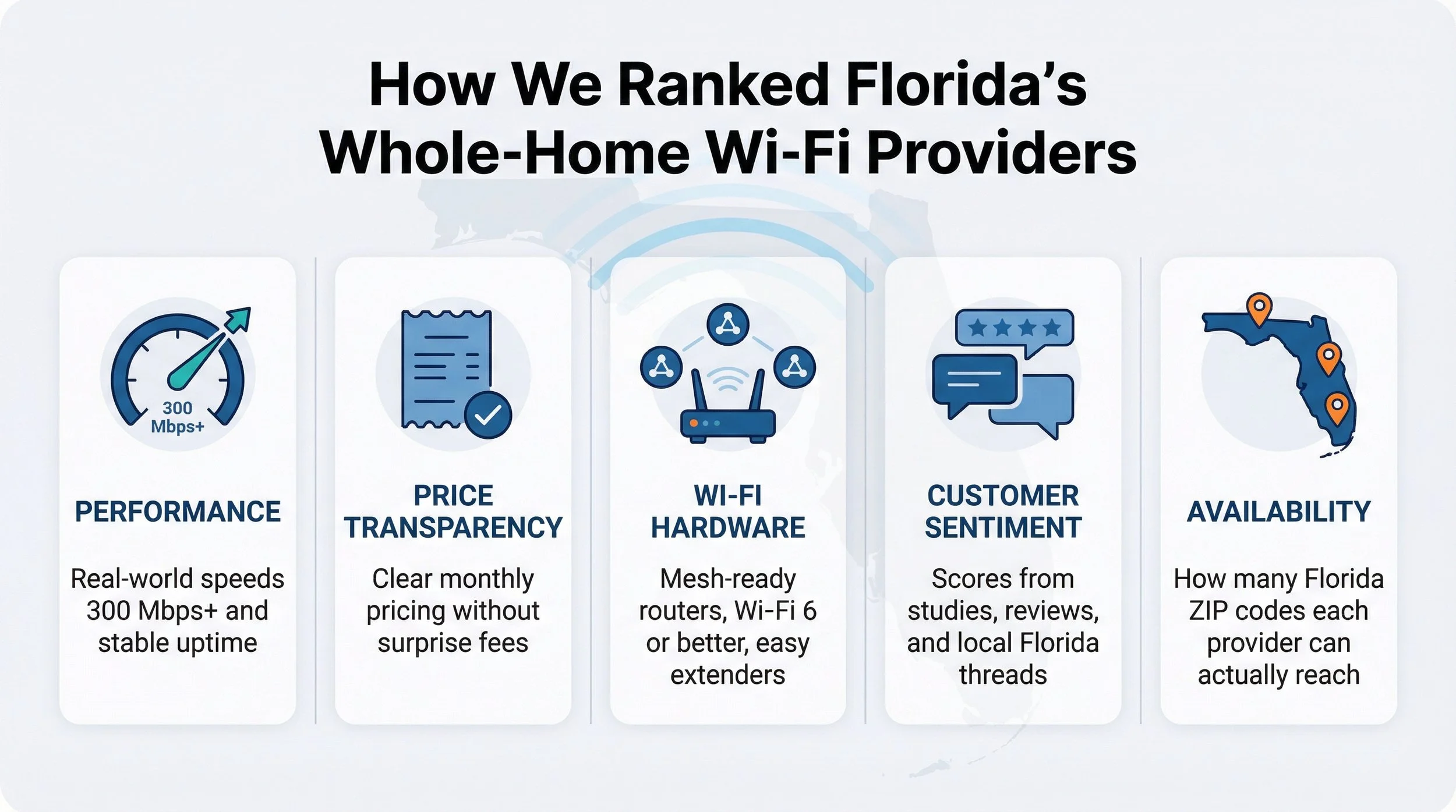
How we ranked Florida’s stand-out providers
Speed means little if the signal dies in your guest bedroom. That’s why we scored each provider on five pillars that shape everyday use.
We started with raw performance. Providers had to deliver at least 300 Mbps downloads and, for fiber, similar uploads in real-world tests. Frequent outages dragged scores down.
Next came price transparency. We rewarded flat monthly rates and penalized second-year jumps or hidden gear fees.
Third, we inspected the Wi-Fi hardware each company installs. Mesh-ready routers, Wi-Fi 6 or better radios, and plug-in extenders earned higher marks because they erase dead zones without extra shopping.
Fourth, we reviewed customer sentiment — J.D. Power scores, Reddit threads, and Florida-specific reviews. A fast router is worthless if support disappears when lightning strikes.
Finally, we weighed availability. A stellar fiber newcomer still slips if it reaches only a few ZIP codes.
Combine those scores and you get the ranking for this guide: clear numbers backed by lived experience.
1. WOW! Internet — best for whole-home mesh flexibility
WOW! doesn’t cover all of Florida, but the homes it does reach enjoy Wi-Fi that bigger brands struggle to match.
The edge is clear: every plan can add a professionally tuned eero mesh system. The base kit costs $9.99 per month, and extra beacons run $5.99 each, according to Allconnect. A technician installs the gear at the same visit that activates your modem.
WOW! Whole-Home WiFi Coverage Guide with Eero Mesh for Florida Homes
Eero nodes speak over a dedicated back channel, so the speed in your upstairs bedroom mirrors the gateway’s output, not some throttled relay. No dead spots, no guesswork with third-party extenders. WOW!’s whole-home WiFi coverage guide notes that two eero beacons usually blanket homes up to 2,000 square feet, while larger or multistory layouts gain from adding a third placed halfway to the trouble room.
Speeds keep pace with the mesh. Older cable zones top out at 1.2 Gbps down, while new fiber builds in Central Florida hit 2–5 Gbps symmetrical. Latency falls, uploads climb, and cloud backups stop clogging the line.
Pricing stays friendly. Plans start near fifty dollars, and WOW! skips contracts and data caps. The bill matches the sales page, and a “Price Lock” add-on can hold that rate for two years.
Customer buzz backs the specs. U.S. News named WOW! a top internet provider for 2024, praising its uploads and overall value. Local Reddit threads report “900-plus rock solid” speeds and “zero regrets” after leaving larger incumbents.
Coverage is the catch. WOW! serves parts of Pinellas County and a growing patch north of Orlando. Check your address before you commit. If you are in range, you get a rare mix of gig-class bandwidth and mesh Wi-Fi that works the first time.
In short, WOW! delivers fiber-grade performance and wall-to-wall coverage without DIY hassle — an easy win if it reaches your street.
2. AT&T Fiber – best for gigabit speed and smart-home headroom
When fiber is available, AT&T leads. Many Florida neighborhoods now qualify for symmetrical 5,000 Mbps service, far beyond cable limits.
That capacity keeps everything running: stream 4K on every TV, back up a terabyte of photos, and still leave bandwidth for cloud cameras while you Zoom.
Every plan ships with AT&T’s Wi-Fi 6 gateway. It covers most single-story homes, and low-cost Smart Wi-Fi extenders snap into the same mesh with no manual setup. The Smart Home Manager app guides placement, shows per-device usage, and lets you pause the kids’ Switch from your phone.
AT&T Fiber Internet Plans and Wi-Fi 6 Gateway for Florida
Prices stay simple. The 300 Mbps tier is about fifty-five dollars, equipment and taxes included. One gig costs eighty. No promo cliffs. No data caps. Multi-gig tiers cost more but still undercut comparable business lines.
AT&T ranks second in the latest J.D. Power satisfaction study for the South, proof that billing and support have improved. Install slots fill quickly, especially during new-build season, so schedule early.
If your address qualifies, you get a double win: symmetrical gigabit speed plus an out-of-the-box mesh that reaches every corner. It is the sort of foundation a growing smart home needs.
3. Xfinity – best all-in-one bundle with xFi controls
Xfinity reaches more than half of Florida addresses, making it the default wired choice for many condos and panhandle suburbs.
Every modern plan ships with the xFi Gateway, a Wi-Fi 6E modem-router. Open the Xfinity app to spot bandwidth hogs, set kid schedules, or spin up a guest network in seconds.
If walls steal signal, Wi-Fi Boost Pods plug into outlets and mesh with the gateway. Comcast even promises a forthcoming “boost guarantee” that adds pods until you see full bars.
Plans start near fifty-five dollars for 500 Mbps with a 12-month intro rate. After year one the price climbs, so set a reminder to renegotiate or pick a fresh promo. Add 25 dollars for xFi Complete; it bundles the gateway, at least one Boost Pod, and removes the 1.2 TB monthly data cap.
Downloads top out at 1.2 Gbps statewide, with limited 2 Gbps nodes. Uploads sit at 35 Mbps today, though 10G upgrades are already pushing 100 Mbps and testing symmetric multi-gig in select areas.
Customer feedback is mixed — strong performance on newer lines, shakier on aging coax. Xfinity’s hotspot network softens outages: step outside and your phone often latches onto a branded access point while crews restore service.
Pick Xfinity if you want one app for internet, TV, and mobile savings and need the option to lift the data cap without shopping for third-party gear. Just watch the renewal date and be ready to negotiate.
4. Spectrum – best no-contract pick with Wi-Fi 7 on deck
Spectrum keeps things simple. Every residential plan arrives without data caps and without annual agreements, so you can start or stop service as your lease or budget shifts.
Speeds start at 500 Mbps for about fifty dollars and rise to one gig for roughly seventy during the first year. After month 13, rates climb unless you renegotiate, but the freedom to cancel makes that call painless.
For whole-home coverage, Spectrum rents an Advanced WiFi router for ten dollars a month. Add one of the new Spectrum Wi-Fi 7 Extenders for five dollars a month and the system flips into mesh mode, broadcasting a single network that reaches upstairs bedrooms and cuts through the concrete block walls common in Florida homes. Wi-Fi 7 silicon boosts capacity and trims latency for device-dense households, according to Charter.
Uploads trail fiber, hovering around 20–35 Mbps today, yet many Florida ZIP codes already see 100 Mbps as Charter upgrades nodes. The 10G roadmap aims for symmetric multi-gig over the same coax within two years.
Customer stories reflect that climb. Users praise the no-cap peace of mind, complain about promo-price creep, and say the extenders erase dead zones in sprawling ranch houses. Wait times grow during summer storms, but the My Spectrum app now handles most resets and mesh tweaks without a support call.
Choose Spectrum if you want contract-free internet, dislike data overage math, and live where fiber is still a rumor. Add a Wi-Fi 7 extender or two and the service moves from good enough to strong for big-home streaming and smart-device juggling.
5. T-Mobile 5G Home Internet – best wireless lifeline for rural and rental living
No trenching, no coax, no appointment window. T-Mobile’s fixed-wireless gateway ships to your door, plugs into a wall, and gets you online in about fifteen minutes. For many Floridians outside the fiber footprint, that pink-accented box is the first taste of modern broadband.
Service is blunt: fifty dollars a month flat, taxes and router included, according to the T-Mobile Home Internet page. Add a qualifying phone plan and the price drops to thirty-five. You get unlimited data, a five-year price-lock, and the freedom to cancel any time without early-termination fees.
Performance hinges on tower signal, but most Florida users see 100–300 Mbps downloads and 15–40 Mbps uploads — enough for 4K streaming and smart-home cameras. Latency averages around 30 ms. Speeds can dip at peak times, yet J.D. Power ranks T-Mobile highest nationwide for wireless-internet satisfaction, suggesting more ups than downs.
The all-in-one gateway broadcasts Wi-Fi 6 across roughly 2,000 square feet. In a multistory house, switch it to bridge mode and pair your own mesh kit. Movers love that ease: unplug, drive, reconnect — no technician.
Limits exist. Carrier-grade NAT blocks inbound ports, complicating self-hosted servers, and heavy rain or distance from the tower can trim bandwidth. Even so, with eligibility now covering millions of Sunshine State homes, T-Mobile 5G Home gives renters, RV owners, and rural families a practical step up from DSL or satellite.
Florida’s fiber boom keeps the options coming
If none of the five providers above reaches your address today, stay patient. Florida’s broadband map shifts almost every month.
The state secured $1.16 billion in federal BEAD grants, money dedicated to wiring farms, fishing towns, and low-income suburbs skipped by cable in the 1990s. Crews are trenching conduit from the Panhandle to the Keys, with completion targets that run into 2026.
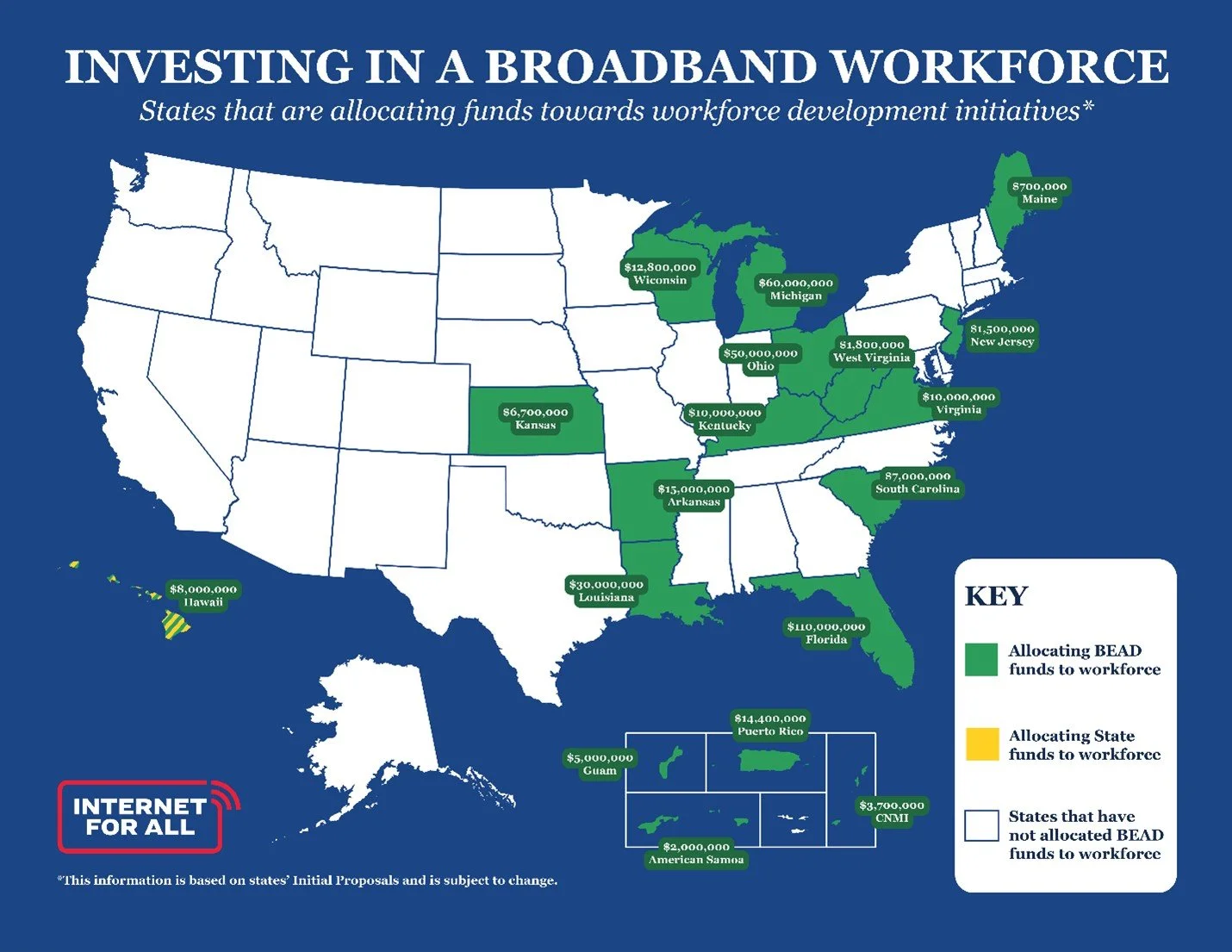
Florida Fiber Internet Expansion and BEAD Broadband Map
Major players are moving fast. Comcast is extending its 10G network into more than twenty rural counties, while Frontier and AT&T rush to light up new XGS-PON fiber zones around Tampa Bay and Volusia County. Newcomers like WOW! and IQ Fiber are carving out multi-gig pockets in Central Florida and Jacksonville.
What does that mean for you? More addresses will qualify for symmetrical gigabit, prices should stay competitive, and the routers shipping with new installs will keep improving, rising from Wi-Fi 6E today to Wi-Fi 7 tomorrow.
How mesh Wi-Fi fills the dead zones
A single router beams signal like a bare lightbulb. Walls, floors, and Florida’s foil-backed insulation soak up that glow, leaving bedrooms and patios in the dark.
Mesh changes that picture. Think of each mesh node as another bulb wired to the same switch. One by the TV, one on the stair landing, maybe a third in the home office. They chat over a hidden back channel, so your phone sees one strong network wherever you walk.
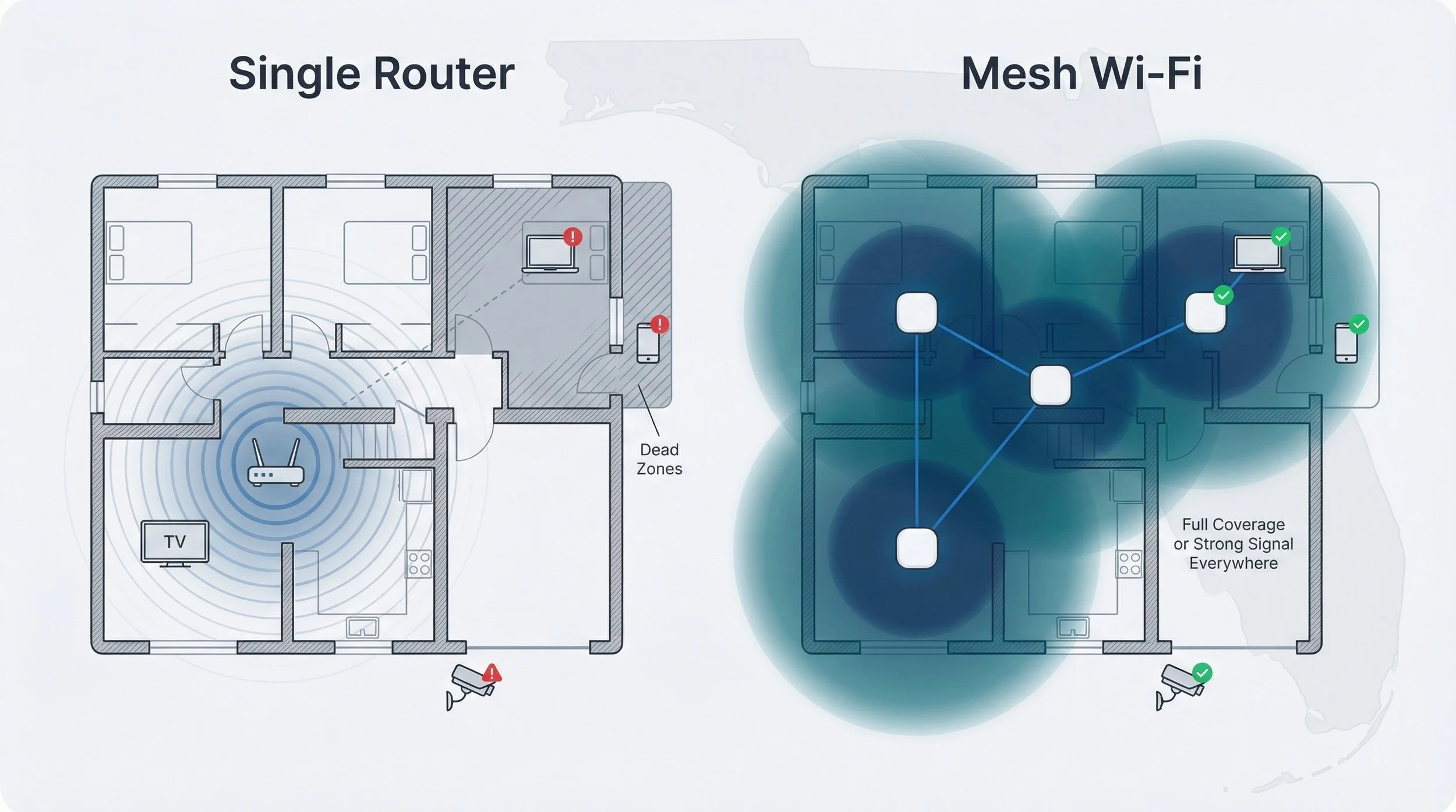
That smooth hand-off matters when you pace through a video call or when your security camera covers fifty feet of driveway. It also ends the “which network am I on?” confusion caused by old-style extenders with separate names.
Every provider in this guide supports mesh. WOW! rents eero beacons, Xfinity sells Boost Pods, Spectrum offers Wi-Fi 7 Extenders, AT&T pairs its gateway with low-cost extenders, and T-Mobile’s gateway can switch to bridge mode for third-party nodes.
Setup is usually app-guided: plug in the pod, wait for a green light, tap “add” on your phone. Spend five minutes with the placement wizard and you finish the day with full-bar coverage in rooms that once buffered.
Before blaming the internet line for choppy streams, open your provider’s app and review the Wi-Fi map. One well-placed mesh node may swap frustration for fast lanes.
Conclusion
Bottom line: if fiber still shows “coming soon” on your street, check again every few months. The odds improve each quarter that a whole-home option lands at your curb.